Who owns Raika? Building and Unbuilding in Contested Landscapes

Introduction
Across contemporary South Asian cities, state authority and infrastructural power are increasingly established not only by acts of construction but also by the material politics of destruction and eviction (Built-UP South-Asia | South-Asia, n.d.). This dynamic is central to debates on the built environment in the region, and Raika is a prime example of how built-up areas are produced through demolition. The 19th May 2026 demolition and eviction drive in the Raika Bandi Forest belt near Sidhra, Jammu, represents this paradox through the erasure of homes, thereby simultaneously clearing space and reordering who counts as legitimate occupants (Wani, 2026). Such tensions are embodied in the claims of different actors. For Gujjar Bakarwal Pastoralists, Raika is both a home and a livelihood, and the Scheduled Tribes and Other Forest Dwellers Act, 2006, provides legal grounds (Recognition of Forest Rights) for asserting customary rights (Ministry of Tribal Affairs, 2012). Temple devotees frame Raika as a sacred landscape linking faith to spatial politics and religious sovereignty (Naik, 2024; Kotwal, 2024). Environmental activists and urban residents defend Raika as an ecological commons and a green buffer, situating their struggle in narratives of environmental justice and civic rights (Correspondent, 2023; Renu Kotwal, 2024). The Forest Department frames Raika as a protected forest, invoking legality and conservation, while the state reclassifies it as an administrative hub (Bukhari, 2023), asserting infrastructural sovereignty and development (KL News Network, 2026).
Together, these competing imaginaries and the paradox of built-up produced through demolition dramatizes wider debates of legality vs legitimacy, environmental justice, competing sovereignties, and indigeneity and citizenship. The essay, therefore, asks three linked questions: How did Raika come to be framed as “encroached”? Who claims the forest and on what ground? And how do competing imaginaries of “built-up” translate into acts of building and unbuilding? To answer, the essay proceeds by situating Raika in its legal and historical context, mapping the claims of different actors, analyzing the paradox of demolition as construction, and reflecting on what justice and development might mean for the contested landscapes in South Asia.
![Figure 1: A member from the Gujjar Bakarwal community standing on the debris of his home, an aftermath of a four-hour-long anti-encroachment drive on the outskirts of Jammu city [Photograph] , by A. Sharma, 2026.](https://static.wixstatic.com/media/5a94cd_5ade542e6b0b41ef8c54a42ec2be07a2~mv2.jpeg/v1/fill/w_800,h_453,al_c,q_85,enc_avif,quality_auto/5a94cd_5ade542e6b0b41ef8c54a42ec2be07a2~mv2.jpeg)
Raika’s Changing Landscape
Raika Bandi lies near Sidhra on the outskirts of Jammu city and is officially part of the Raika Bahu Forest area, an eco-sensitive zone under the Bahu Conservation Reserve (Naik, 2024). The Bahu Conservation Reserve was established in 1981 and covers about 19 square kilometres. It is located just 3.75 km from the Ramnagar Wildlife Sanctuary and is home to many indigenous plant and animal species, such as Rock Pigeon, Asian Koel, and Red-Vented Bulbul (Renu Kotwal, 2024). Raika Bandi Forest is not simply a patch of trees on a map but a living social landscape where different groups use, shape and reclaim the forest according to their distinct needs, rights and positions of power. With the official announcement of the Bahu Conservation Reserve, the Forest Department views Raika as a protected area, governed under conservation laws (Daily Excelsior, 2026; KL News Network, 2026). Thus, any act of deforestation or construction of structures is considered illegal and a violation of the forest laws. For generations, Raika was used and lived on by Gujjar Bakawal tribal communities (Athar, 2017). Members of this pastoral and nomadic community depend on pastoral land for their livelihood. Initially, Raika was not an empty forest but a place to live, raise families, and a space tied to their identity, culture, and history.
For many Hindu residents of Jammu, Raika Forest is a sacred landscape where faith is linked to religious legitimacy over the region (Naik, 2024). The forest is not merely a physical terrain but a symbolic space through which cultural authority is expressed. As such, any disruption to the existing status is often seen as threatening the continuity of worship and established cultural claims. Urban residents and activists often defend the Raika as an ecological commons and a green buffer (Correspondent, 2023; Kotwal, 2024). They view their relationship with Raika as civic and environmental, in which the forest belt is valued as a space for public health, environmental justice, and collective rights. Finally, for the state, Raika is reclassified as an administrative hub, infrastructural sovereignty is asserted through developmental projects, government offices and the expansion of urban governance into the forest and its surrounding areas (Bukhari, 2023).
On the early morning of 19th May, a joint drive by the Forest Department, Forest Protection Force, Revenue Department, and Police demolished around 32 structures in the Raika Bandi forest belt near Sidhra, on the outskirts of Jammu city (Daily Excelsior, 2026). Officials claimed that the demolished structures were illegal encroachments and that about 3 hectares (around 60 Kanal) of forest land was reclaimed (Daily Excelsior, 2026). However, it later emerged that around 40 tribal homes of the Gujjar Bakarwal communities were destroyed, triggering outrage among civil society and political parties (Wani, 2026). What began as a court- ordered ‘anti-encroachment’ drive turned into a political and moral crisis (Daily Excelsior, 2026).
Government and forest records classify Raika as forest land under state control, and any illegal structure in the region is considered a violation of the Forest Laws (Daily Excelsior, 2026). And often such settlements were termed "encroached". But for the pastoral and nomadic families from the Gujjar Bakarwal community, the forest has been their home for generations. They do not simply consider Raika as a tract of forest land but as a lived landscape woven into memory, relationship and history. The Gujjar Bakarwal community often firmly fixes forests in their everyday practice of belonging, where access and use are tied to kinship and collective memory. Like all the pastoral and tribal communities, the Gujjar Bakarwal community also perceives forests as social territories, where rights are negotiated through customary practices and collective institutions (Sivaramakrishnan, 1999; Sundar, 2000). With the ecological knowledge and cultural memory being inseparable for the community, the forests serve as archives of history and continuity (Baviskar, 1995; Gadgil & Guha, 1992). In this sense, Raika is experienced by Gujjars as a site of ancestral relationship and historical legitimacy. The eviction thus unsettles not only the material shelter but also the symbolic continuity of memory and belonging (Agrawal, 2005).
Although the eviction drive was carried out with the orders from the Lieutenant Governor, the elected government and the forest minister denied any involvement, leading to a political tussle over responsibility. The elected government and the tribal representatives alleged that the drive violated the Scheduled Tribes and Other Forest Dwellers (Recognition of Forest Rights) Act 2006. In response, a two-member fact-finding committee was constituted to investigate the demolition of houses and the eviction of Gujjar Bakarwal families, further exposing the contested legal and political claims surrounding Raika (Daily Excelsior, 2026). These claims surrounding Raika reveal that demolition is not merely an act of removal but a constitutive process of building. The destruction of Gujjar Bakarwal homes demonstrates how “built-up” is produced through unbuilding. Such eviction clears space for new classifications, infrastructures and sovereignties, while simultaneously erasing the material and symbolic continuity of pastoral life. In this sense, demolition itself becomes a mode of construction, thus producing new landscapes of legality, development and authority even as it dismantles existing ones. While the Forest Department justified the demolition by citing the Jammu and Kashmir High Court’s order dated 03.09.2020 in SAVE Vs State of J&K & Ors (PIL No. 25/2017), which directed the removal of all encroachments from forest lands in a time-bound manner (Daily Excelsior, 2026), this justification raises a more fundamental question: who is recognised as an encroacher?
According to a written response submitted by the Forest Department to the Jammu and Kashmir assembly in 2025, 19,482.94 hectares of land in the Union Territory were under encroachment (Fayaz Wani, 2025). While this official figure reflects the scale of the issue in the Union Territory, the Raika Bahu forest exemplifies how urban expansion has also transformed forest margins into contested spaces. Due to the sudden expansion of urbanism in Jammu, local residents were selling land adjacent to Raika to outsiders without a legal transfer. The area of Qasim Nagar, Bathindi, and Malik market is largely encroaching upon the Raika Bahu Forest. According to the protesting participants, after the demolition, they stated that many communities and societies were established in this region under the guise of the forest department and with the consent of the government, and that bills and water bills served as important documents for the transfer of such lands (Interview, 20 May 2026). New settlements and colonies in the form of ghettos were built, often encroaching on Raika’s forest lands. As settlements expand, the forest continues to shrink, and pressure increases. The surrounding residents started to view and utilise Raika to their own needs. One such sinister development took place in the neighbouring Qasim Nagar, where drug peddling is rampant, thus adding to the host of social and cultural evils (Daily Excelsior, 2026). The built-up form of construction surrounding Raika thus has unintended impacts on Raika as it transforms into a recreational space. The extent of unauthorised construction around Raika became particularly evident during the anti-encroachment drive along the Narwal Bypass undertaken as part of the Delhi-Katra Expressway (NE-5) project, when numerous structures were demolished, triggering protests and incidents of stone-pelting by residents (KL News Network, 2026).
These unintended consequences of urban expansion, from unauthorised colonies to social evils and violent protests, sharpened the sense that Raika was not simply a shrinking forest margin but a vital civic space under threat. As the forest was increasingly consumed by settlements and infrastructural projects, urban residents and activists of Jammu began to articulate a counter-claim: Raika must be defended not as vacant land but as an ecological commons essential to the city’s survival. The pressures of unauthorised construction and urban expansion around Raika sharpened ecological concerns in Jammu. As settlements expanded and forest margins shrank, the city began to experience rising pollution, intensifying heat, and worsening noise levels. These emergent issues are not incidental but central to debates on built environments in South Asia, showing how built-up areas are produced through construction at the expense of ecology, with new urban landscapes emerging even as ecological buffers are erased. For residents of Jammu city, Raika Mahamaya Forest is one of the last surviving green belts on the city's outskirts (Kotwal, 2024). Amid these pressures, civic groups and environmental activists mobilized to defend Raika. Save Raika, an organization protesting the shifting of the High Court of Jammu and Kashmir and Ladakh, terms Raika as “The Lungs of Jammu City” (Correspondent, 2023; Down To Earth, 2021). It acts as a natural buffer against pollution, heat and noise. And, as many term it, it is not just an empty land but a breathing space for Jammu city. Urban residents and activists thus occupy a peculiar position: they resist both the demolition of tribal homes and the expansion of unauthorized colonies, insisting that preservation itself is a form of building civic life. Their struggle against the proposed construction of the High Court of Jammu and Kashmir and Ladakh in Raika (Down To Earth, 2021) dramatizes the paradox of built-up produced in destruction. For them, deforestation and eviction are not neutral acts of clearing but the violent unbuilding of ecological and civic continuity, carried out in the name of reclassification. In this way, urban residents and activists together emerge as a distinct actor, reframing Raika as a civic landscape whose survival is inseparable from the well-being of Jammu city.
![Figure 2: Young Climate Activists, part of Save Raika group, protesting against the shifting of J&K and Ladakh High Court to Raika [Photograph], by R. Kotwal, 2024.](https://static.wixstatic.com/media/5a94cd_a757fab4e6724e85b221fdaa09f63594~mv2.jpeg/v1/fill/w_980,h_784,al_c,q_85,usm_0.66_1.00_0.01,enc_avif,quality_auto/5a94cd_a757fab4e6724e85b221fdaa09f63594~mv2.jpeg)
The State, one of the most powerful actors in the contested landscape of Raika Forest, views and characterizes it not as a commons or ancestral home but as an administrative and tourism hub. Driven by this orientation, successive governments began to reimagine Raika through the construction of infrastructures such as the Forest Resource Management Centre, Jammu and Kashmir Forest Department office buildings, Directorate of Soil and Water Conservation, Mahamaya Ropeway Station, and eventually the proposed seat of the Jammu and Kashmir and Ladakh High Court (Bukhari, 2023). Amongst these projects, the Mahamaya ropeway project is particularly significant, as it integrates Raika into the tourism economy. In this framing, built-up is equated with the expansion of state authority and infrastructural sovereignty: forests are unbuilt as ecological and social landscapes in order to be rebuilt as administrative complexes and tourist attractions. The State thus emerges as an actor that translates legality into development, producing new landscapes of governance while simultaneously dismantling older ones.
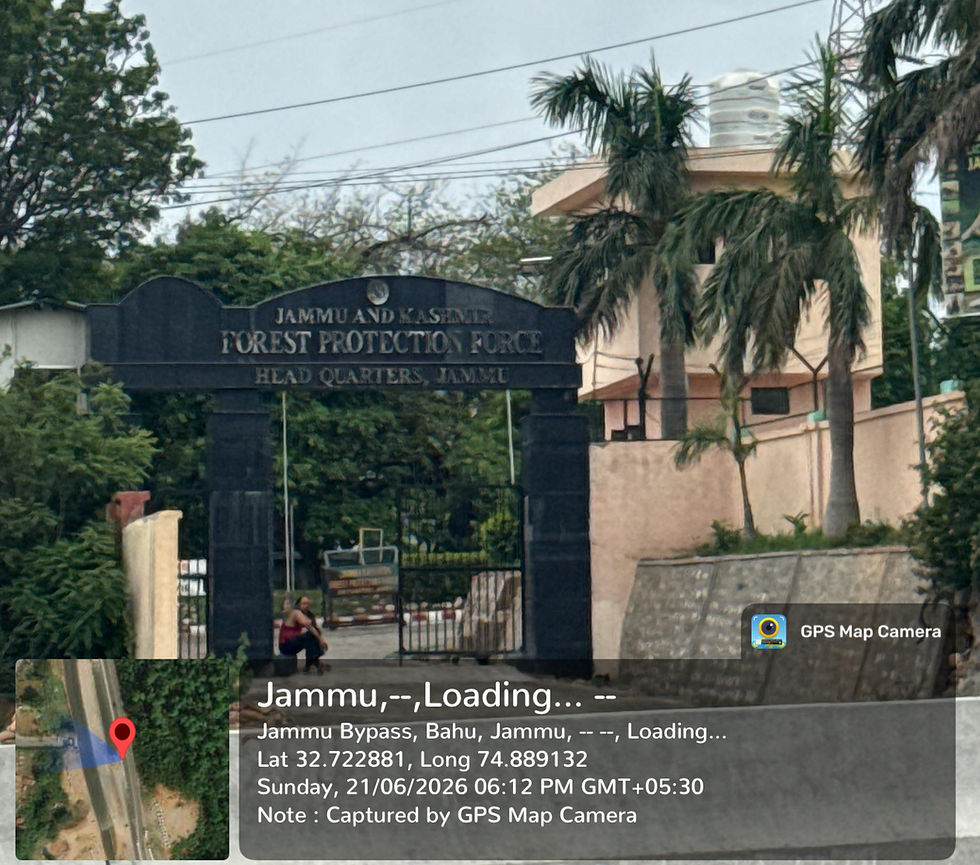
It is through the Mahamaya ropeway project that another powerful actor emerged: the temple devotees (Naik, 2024; Kotwal, 2024). Raika Bahu forest area is also home to two major sacred sites: The Bawe Wali Mata Mandir (Bahu Temple) and the Mahamaya Temple. Pilgrims flock to the Temple on Tuesdays and Sundays (considered auspicious days), and the forest around these sacred Temples is protected by tradition and faith. Between these two temples lies the Old Tawi Herbal Eco Park. These sacred landscapes of Jammu are connected via cable car and visited by both devotees and tourists. Providing a panoramic view from both these locations of the river Tawi and Jammu city. Besides the Bahu Temple, the Bahu Fort, one of the oldest forts in Jammu, originally built by Raja Bahu Lochan over 3000 years ago as a vital political seat for his empire, now serves as a major tourist spot. Temple devotees reveal another dimension of “build-up” in contested landscapes: they assert cultural sovereignty by protecting Raika through sacred traditions and faith. Through ritual, pilgrimage, and the continuity of worship, they construct Raika as a spiritual commons whose survival is inseparable from Jammu’s cultural identity. Their presence shows that built-up is produced not only through state infrastructures and activist resistance but also through sacred claims, in which protection itself becomes a mode of constructing cultural sovereignty.
Competing Imaginaries of different actors
The contested landscape of Raika can be understood through the claims of different actors. Each imagines Raika differently: as a home, a forest, a hub, a sacred site, or a commons. These meanings shape their desired futures for Raika, and those desired futures could only be realised through a particular form of built-up. The following table summarizes these divergent positions.
Actors | Meaning of Raika | Desired Future | Imagined built-up and its consequences |
Gujjar Bakarwal | Home; grazing commons | Secure livelihood; tenure recognition | Small-scale housing and animal shelters; informal built-up that supports pastoral life; eviction causes livelihood loss |
Forest Department | Protected forest | Conservation; legal enforcement | Removal of structures; reforestation; administrative infrastructure to assert control |
State/ Development planners | Administrative/tourism hub | High-profile built projects (ropeway, offices, High Court) | Large-scale built-up; roads and institutional complexes; displacement and reclassification of land |
Devotees/Temple authorities | Sacred landscape | Religious protection; pilgrimage infrastructure | Paths, viewing platforms, small facilities; selective protection of temple precincts |
Activists/ Environmentalists | Ecological commons | Conservation and public green space | Limits on built-up; campaigns against tree-felling; legal petitions |
Taken together, this mappings showcases how demolition and construction are inseparable: eviction produces new sovereignties, preservation becomes civic building, and sacred protection asserts cultural sovereignty. Raika thus emerges not as a singular landscape but as a contested terrain where legality, livelihood, ecology, governance, and faith collide.
Contested Justice and Built-up through Demolition
Raika’s contested future reveals that justice and development cannot be understood apart from the paradox of built-up. In this landscape, construction and demolition are inseparable: bulldozers and rubble are as much part of the built environment as roadways and offices (Built-UP South-Asia | South-Asia, n.d.). Built-up here is not only what is erected but also what is erased, displaced, and reclassified in the name of progress. For Gujjar Bakarwal families, demolition dismantles ancestral continuity and livelihood. For activists, preservation itself becomes a civic form of construction. For the Forest Department, legality justifies removal. For the state, infrastructure reclassifies commons into administrative hubs. For temple devotees, sacred protection asserts cultural sovereignty. These competing imaginaries show that justice in Raika is contested, and development is visible as much through loss and displacement as through new projects.
Immediate justice requires halting future demolition, instituting a transparent enquiry into the nature of built-up, and providing relief to displaced families by restoring dignity and rights (Sharma, 2026). Long-term justice demands recognition of tribal rights under the Scheduled Tribes and Other Traditional Forest Dwellers (Recognition of Forest Rights) Act, 2006, and genuine independence of fact-finding committees (Ministry of Tribal Affairs, 2012). Yet the deeper issue is how built-up itself has emerged under the gaze of the Forest Department and with the consent of the state – legitimizing some through electricity and water bills while branding poor tribal families as encroachers (Daily Excelsior, 2026). Built-up has created a class divide, privileging elites while marginalizing those whose lives are most deeply tied to the forest (Athar, 2017). Raika thus exemplifies how development in South Asia is made visible not only through construction but also through demolition (Built-UP South-Asia | South-Asia, n.d.). Justice must confront this paradox: building and unbuilding are inseparable acts that shape contested landscapes. The question is no longer simply who owns Raika, but whose vision of built-up, though both construction and destruction, will prevail, and at what cost to those whose lives and identities remain bound to the forest.
References
Agrawal, A. 2005. Environmentality: Technologies of government and the making of subjects. Duke University Press.
Athar, P. (2017, March). Nomadic Gujjars and Bakerwals Face Eviction Drives in Jammu. Land Conflict Watch. https://www.landconflictwatch.org/conflicts/gujjars-of-jammu-and-kashmir-vs-forest-department#
Baviskar, A. 1995. In the belly of the river: Tribal conflicts over development in the Narmada Valley. Oxford University Press.
bUILT-Up SOUTH-ASIA. (2026, May 14). bUILT-Up SOUTH-ASIA. Retrieved June 2, 2026, from https://www.builtupsouthasia.com/
Bukhari, M. (2023, February). Jammu and Kashmir government to displace communities and cut 38000 trees for its new High Court complex. Land Conflict Watch. Retrieved June 2, 2026, from https://www.landconflictwatch.org/conflicts/jammu-and-kashmir-government-to-displace-communities-and-cut-38000-trees-for-its-new-high-court-complex#
Correspondent, O. (2023, December 10). Help save Raika forest, Jammu citizens’ group urges CJI Chandrachud - The Tribune. The Tribune. https://www.tribuneindia.com/news/j-k/help-save-raika-forest-jammu-citizens-group-urges-cji-chandrachud-570588/
Daily Excelsior. (2026, May 19). 60 kanals of encroached forest land retrieved during eviction drive at Raika Bandi area. Daily Excelsior., https://www.dailyexcelsior.com/60-kanals-of-encroached-forest-land-retrieved-during-eviction-drive-at-raika-bandi-area/.
Daily Excelsior. (2026, May 23). Govt justifies demolition of illegal structures at Raika Bandi in Sidhra. Daily Excelsior., https://www.dailyexcelsior.com/govt-justifies-demolition-of-illegal-structures-at-raika-bandi-in-sidhra/.
Daily Excelsior. (2026, July 15). Woman among two drug peddlers held with heroin in Samba, Rajouri.Daily Excelsior. https://www.dailyexcelsior.com/woman-among-two-drug-peddlers-held-with-heroin-in-samba-rajouri/
Fayaz Wani. (2025, October 27). Over 19,000 hectares of forest land illegally occupied in J&K. The New Indian Express. https://www.newindianexpress.com/india/2025/Oct/27/over-19000-hectares-of-forest-land-illegally-occupied-in-jk
Gadgil, M., & Guha, R. (1992). This fissured land: An ecological history of India. Oxford University Press.
KL News Network. (2026, May 20). Jammu Kashmir: Govt Constitutes Enquiry Committee Over Demolition of Tribal Houses in Sidhra. Kashmir Life. https://kashmirlife.net/jammu-kashmir-govt-constitutes-enquiry-committee-over-demolition-of-tribal-houses-in-sidhra-436970/
KL News Network. (2026, July 11). Jammu Kashmir: Govt approves rehabilitation of shopkeepers affected by Expressway project. Kashmir Life - Latest News & Breaking
News From Kashmir. https://kashmirlife.net/jammu-kashmir-govt-approves-rehabilitation-of-shopkeepers-affected-by-expressway-project-442742/
Ministry of Tribal Affairs. (2012). Forest Rights Act, 2006: Act, Rules and Guidelines. Government of India. https://tribal.nic.in/fra/data/frarulesbook.pdf
Naik, M. (2024, September 17). 'Save Raika Forest': Is Climate Activism Being Criminalised in Jammu? The Quint. https://www.thequint.com/climate-change/raika-forest-tawi-river-is-climate-activism-being-criminalised-in-jammu
Kotwal,Renu. (2024, April 24). Jammu’s Chipko moment: Green activists protest plan to chop 38,000 trees in Raika. Down to Earth. https://www.downtoearth.org.in/environment/jammu-s-chipko-moment-green-activists-protest-plan-to-chop-38-000-trees-in-raika-75649
Sharma, A. (2026, May 27). ‘Will act against officials who demolished your homes’: J&K minister to Gujjar-Bakarwals on Eid. The Indian Express. https://indianexpress.com/article/india/jammu-raika-bandi-forest-demolition-javed-rana-gujjar-bakarwal-fra-10711023/
Sharma, A. (2026, May 19). Anti-encroachment drive in Jammu forests sparks political controversy - The Tribune. The Tribune. https://www.tribuneindia.com/news/j-k/anti-encroachment-drive-in-jammu-forests-sparks-political-controversy/
Sivaramakrishnan, K. 1999. Modern forests: Statemaking and environmental change in colonial Eastern India. Stanford University Press.
Sundar, N. 2000. Unpacking the “community” in community resource management. In P. Agrawal & C. Gibson (Eds.), Communities and the environment: Ethnicity, gender, and the state in community-based conservation (pp. 139–174). Rutgers University Press.
Wani, F. (2026, May 19). Outrage after 40 tribal houses demolished in Jammu; minister orders inquiry. The New Indian Express. https://www.newindianexpress.com/india/2026/May/19/outrage-after-40-tribal-houses-demolished-in-jammu-minister-orders-inquiry-halts-drive

Irfan is currently working as a Facilitator at the Village Lab Foundation in Ladakh, engaging with community-based education initiatives rooted in Indigenous knowledge systems. He holds a Master's degree in Political Science and Government from the University of Jammu. His research interests centre on Himalayan communities, with a focus on pastoralism and climate change adaptation, drawing on field-based and qualitative research in the region. Currently, he is pursuing an MA in Development Studies at IIT Mandi, deepening his work at the intersection of development, ecology, and mountain societies.

Nary is currently working as a Facilitator at the Village Lab Foundation in Ladakh, engaging with community-based education initiatives rooted in Indigenous knowledge systems. She graduated with a Bachelor's in Social and Political Sciences (Honors) from Ahmedabad University. During her undergraduate years, she worked as a Research Assistant studying extreme weather trends in India, and served as a Student Ambassador at Lingnan University, Hong Kong. Currently, she is pursuing an MA in Development Studies at IIT Mandi, exploring how traditional knowledge and Himalayan communities shape meaningful, culturally-rooted education.


Comments